Tree Trimming - Vegetation Management
How Tree Trimming Keeps Your Power On!
Reducing power outages benefits everyone. NES’ enhanced tree-trimming and vegetation-management plan provides a cost-effective, efficient way to minimize outages, particularly during storms. This map shows strong evidence that increased tree clearance improves customer reliability. Circuits highlighted in yellow were trimmed recently to meet new Vegetation Management standards, which require 15 feet of clearance on each side with no overhang. The prior policy was a 10-foot clearance and allowed overhang. On this map, the green dots represent the outages that were experienced during the April 16 storm. We see clear improvements in reliability circuit-to-circuit, and as this work continues, all customers will benefit.
There is a correlation between the vegetation management efforts and improved reliability during the April 16 storm. While some outages may still occur due to entire trees falling or other unrelated causes, the overall likelihood of outages is expected to decline as this work continues. In June 2026, we completed our goal for the number of miles trimmed. This initiative will complete the previous four-year trim cycle and allow NES to begin the new three-year accelerated trim cycle as planned.

Three Things to Know
What it is
A digital model of NES infrastructure that reflects current conditions on the grid, built to help us catch issues early and spot opportunities to strengthen the system.
What we model
Building load, transportation, and the electrical grid across neighborhoods with the assumptions and data sources published alongside it.
What it means for you
Fewer surprise outages over time, and a clear place to see what’s planned for your part of the grid
-
Why does NES trim customer trees and is this a one size fits all approach?
Tree trimming is a planned, data-informed part of Nashville Electric Service (NES)’s Vegetation Management (VM) Program to keep customer trees and power lines safely separated. Tree trimming reduces outages, protects public safety, and maintains system reliability. Vegetation growing in the wrong place can disrupt power, damage NES facilities, and pose safety hazards to workers and the public. NES’ goal is to promote tree vitality while ensuring they do not interfere with electrical equipment.
Vegetation Management is not a single action; it varies based on line type, location, vegetation characteristics, and risk.- Routine cycle trimming: Scheduled maintenance performed across the system to maintain required clearances. NES is currently on a 4-year trim cycle, covering approximately 1,200 miles per year and will be moving to a 3-year trim cycle of approximately 1,600 miles per year.
- Hazard tree mitigation: Targeted trimming or removal of dead, diseased, damaged, or structurally unsound trees that could strike power lines.
- Secondary/service line trimming: Limited trimming is conducted when vegetation presents a realistic risk of abrasion, strain, or outage.
- Unplanned Vegetation Management work: Includes emergency, storm, hazard-trimming requests, engineering/operations requests for construction or maintenance, and hot spot or cycle buster for circuit reliability.
-
How is the space between a customer tree and lines determined?
Tree trimming clearances are established based on factors that account for the best weather and the worst weather conditions:
- Storm hardening objectives
- Nominal line voltage
- Expected tree and conductor sway/movement under both routine and severe weather conditions
- Trim-cycle length
- Conductor sag due to load and temperature variations.
The updated clearances are as follows:
- Distribution Lines: All branches/limbs fifteen feet from the conductors, and any overhang should be removed. Vegetation ten feet below the system neutral may be ok to stay in place, but must be trimmed if they grow into the clearance space.
- Transmission Lines: All branches/limbs fifteen feet from the conductors in all directions, and any overhang should be removed.
-
Why did NES adopt an enhanced tree trimming policy?
Previously, NES targeted roughly 1,200 miles of our system for utility vegetation management work each year to ensure a 3–4-year maintenance cycle for our 4,600 miles of overhead power lines. Since 2022, we have averaged 75% completion of this goal, while accounting for factors such as necessary vendor changes, variable weather, and terrain difficulty. The new target will be 1,600 miles of vegetation management and tree-trimming per year to bolster maintenance goals.
Between July 2025 and January, NES completed approximately 600 miles of planned line trimming for the year. Since Winter Storm Fern began, crews have assessed and trimmed over 2,800 miles of additional lines to address overhanging and storm-damaged trees that pose a risk of outages. An enhanced policy supports a broader commitment to fulfilling 100% of the goal for
the year.Vegetation-related damage has been a primary cause of outages during major weather events. Tornadoes, straight-line winds, winter storms, and severe storms account for 19 of Tennessee’s 20 Federal Major Disaster Declarations since 2020
-
How do we know enhanced tree trimming is appropriate for our canopy?
- The independent, interim after-action review has validated enhanced vegetation management as critical to the health of our system and the appropriate action:
- NES recognized vegetation management was a contributor to outages in Fern. Immediately following Fern, NES took appropriate, aggressive action to enhance vegetation trimming standards (wider clearances between trees and power lines, as well as removing any overhanging limbs). (PA Consulting Report April 2026)
- Memphis (MLGW) experienced a harsh ice storm three years ago, and MLGW adopted an enhanced tree trimming policy as a part of a greater reliability plan, which has
resulted in the total average minutes their customers experience each year in half. The renewed efforts have had a marked impact on the reliability of MLGW’s electric grid.
Metric Memphis Nashville Electric Customers Served
440,000 460,000 Distribution line miles over 4,300 over 4,600 Service area 1,100 700 Tree Canopy * ~37% tree canopy ~41% tree canopy Target annual trim miles 1,400 1,600 - The independent, interim after-action review has validated enhanced vegetation management as critical to the health of our system and the appropriate action:
-
How does NES plan and execute tree trimming?
Tree trimming decisions are informed by data, a team of certified arborists, and standardized methods.
- Technology: NES is now equipped with advanced tools, such as LiDAR, for future trimming plan considerations. Year-over-year data will illuminate areas where the trim cycle can be lengthened and where faster-growing vegetation needs more frequent attention.
- Professional review: Certified arborists and vegetation management specialists assess sites, prescribe work, and oversee work execution. Currently, we have increased oversight and quality control through additional arborists to ensure the implementation of the enhanced policy.
- Standards-based methods: NES contracts require the use of lateral pruning, as endorsed by the International Society of Arboriculture (ISA) and the Arbor Day Foundation. Lateral pruning preserves tree structure, improves resistance to high winds and heavy ice, and guides growth away from power lines
-
What is the simplest way to understand if a tree should be trimmed?
If you answer “yes” to any of the following questions, your tree may need to be trimmed or removed.
- Can a branch reach the line during wind or ice?
- Is the tree directly under or overhanging a power line?
- Is it within 15 feet of the electrical line?
- Is the tree dead, leaning, cracked, or decaying?
- Could trimming now prevent emergency cutting later?
-
How does NES let customers know about upcoming tree trimming?
NES is not legally obligated to notify customers prior to vegetation management work near power line corridors, but we want everyone to be informed, so we utilize several outlets to communicate with customers along planned trimming corridors and property owners with trees near overhead lines, such as:
- Advance notification via phone calls, emails, door hangers, and mailed postcards, when appropriate
- On-site conversations between crews/arborists/VM specialists and property owners
- Graphics and educational resources on our website
- Dedicated channels for questions, follow-up, and access to management if needed
- A dedicated hotline for tree trimming has been established with our customer team and can be reached at 615-695-7400
-
How does NES handle customer concerns?
Customer concerns can be addressed at any point in the work process:
- Before trimming: Tree Trimming dedicated hotline 615-695-7400
- During trimming: On-site conversations between crews/arborists and property owners
- After trimming: Tree Trimming dedicated hotline 615-695-7400 /VM specialists
-
Does NES clean up?During planned cycle maintenance work, debris is generally cleaned up during the initial job, but all debris should be removed within 48 hours of the trimming completion. NES does not remove debris resulting from acts of God or during storm/outage restoration efforts.
-
Does NES replace trees?Yes, NES works with homeowners to provide a replacement tree if a healthy tree must be fully removed.
-
What are the removal standards and quality control?
- NES contracts require the use of lateral pruning, as endorsed by the International Society of Arboriculture (ISA) and the Arbor Day Foundation.
- NES is recognized by the Arbor Day Foundation as a Certified Tree Line USA utility, reflecting excellence in vegetation management.
- NES management and arborists oversee trimming.
-
What is the process for trees on public property?NES is not legally obligated to notify customers prior to vegetation management work near power line corridors, but we want everyone to be informed so we attempt to coordinate directly with appropriate jurisdictions if parks or other public lands require trimming.
Converting Overhead to Underground
Underground Power Lines: What to Know!
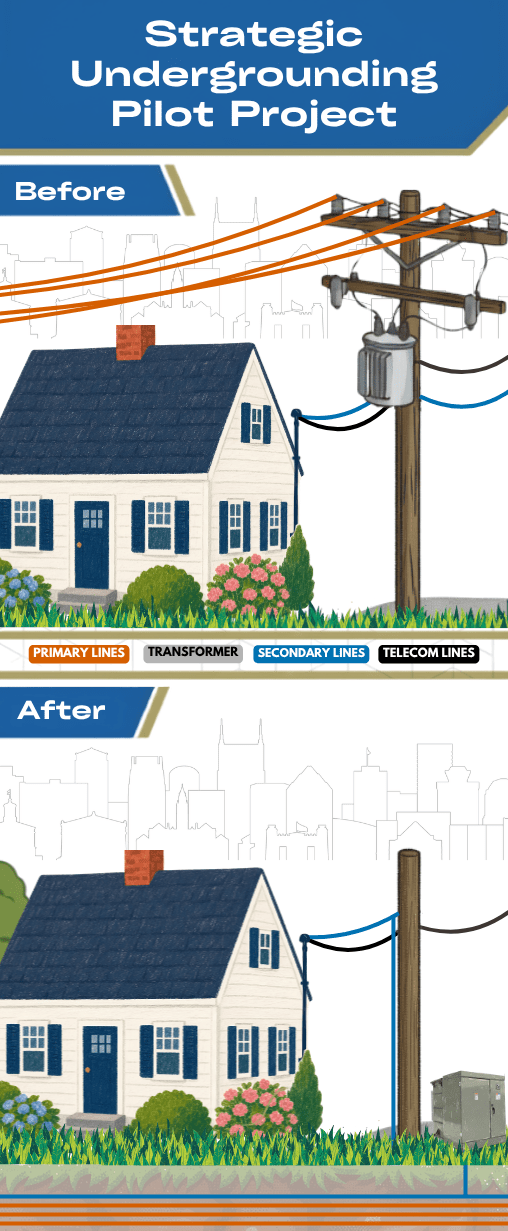
For years, NES has underground power lines in some new construction, per local ordinances. In fact, approximately 20% of the NES distribution system is already underground, and we continue to underground new services and developments every day. Now, we are conducting a System-wide Underground Study and Strategic Undergrounding Pilot Program to collect information on where converting overhead lines to underground is a good fit for our system and customers. While there are benefits, undergrounding is not always the right answer. NES is using data to figure out where conversion works well and where it does not.What Does “Undergrounding” Mean?
Underground systems are generally separated into primary and secondary systems. The primary system is the conductor you see attached at the top of the pole, running along the street. Secondary systems are the low-voltage wires that run from the transformers to homes and businesses. Undergrounding the primary system involves moving power lines from overhead poles to below ground. This involves burying wires and installing underground equipment, like pad-mount switches and transformers. Undergrounding the secondary system would involve moving the service wire connecting homes and businesses underground.What NES Is Doing Now?
NES is running a Strategic Undergrounding Pilot Program to see how converting overhead lines underground works in real-world situations across our system. Simultaneously, a System-wide Underground Study is underway to understand feasibility, costs, benefits, and tradeoffs across the entire service territory. We will continue installing many new underground electrical facilities every day.What NES Hopes to Learn
The pilot program will help NES better understand:
- How undergrounding performs in different environments
- Benefits of different construction methods
- The cost per project and per customer
- Customer impacts during construction
- Whether reliability improvements justify the cost